Integral Well-Being

Caring for the whole person.

Integral Well-Being is the development of conditions and resources that support a healthier and more meaningful life in the biological, Soul, social and spiritual dimensions, reflected in relationships, family, work and participation in society.

Our perspective does not start from illness, but it does not ignore suffering when it is present.

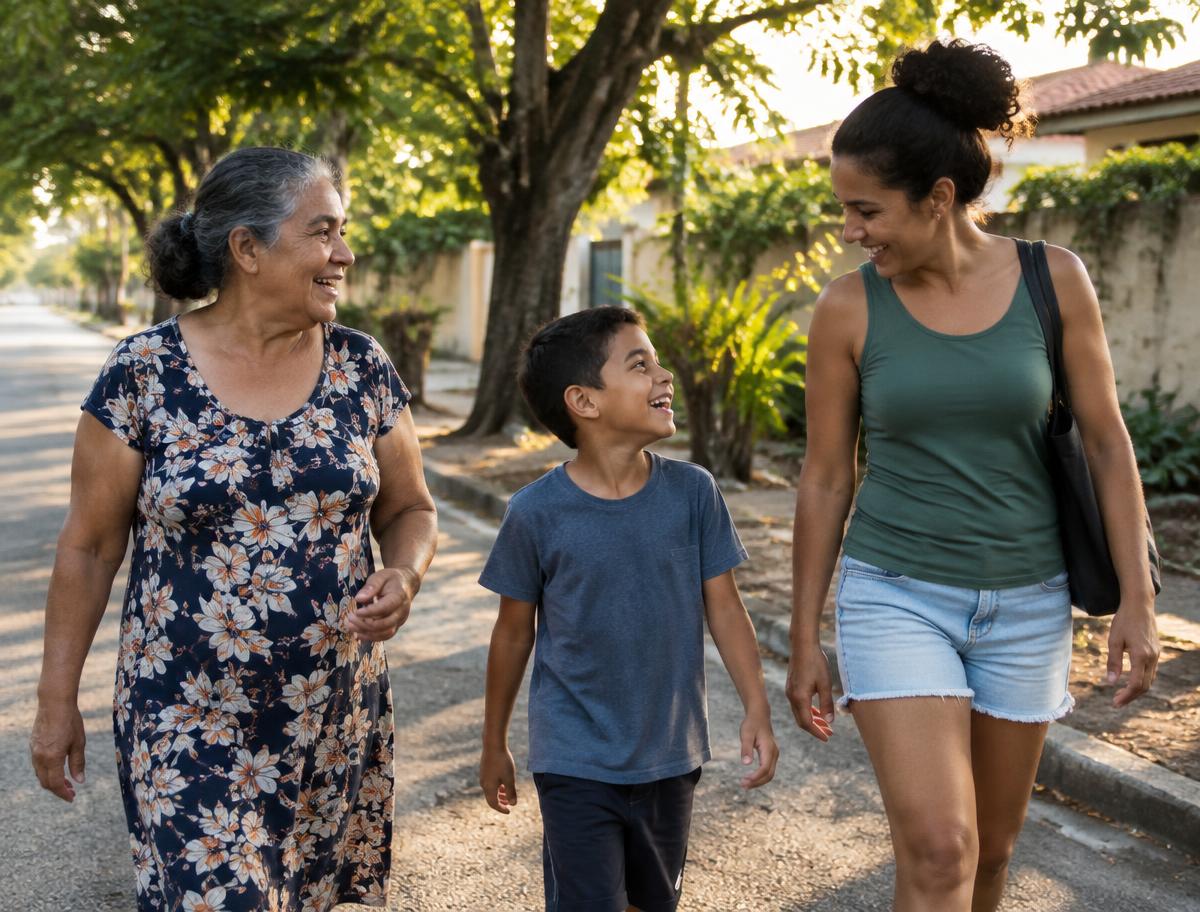
A grandmother, mother and son walk together along a tree-lined street, talking and smiling in the late afternoon.

We are whole.

Body, thoughts, emotions, relationships, personal history, environment, values, spirituality and purpose are all part of human experience.

These dimensions do not exist in complete isolation. What happens in one area of life can influence others.

That is why understanding the person as a whole broadens the possibilities for care, development, prevention and strengthening of resources.

The four dimensions

Biological | The body takes part in our story.

  • body
  • health
  • sleep
  • nutrition
  • movement
  • energy
  • habits
  • physical conditions
  • physiological rhythms
  • self-care

The body is not merely a support for life. It continually takes part in our experiences, limits, possibilities and ways of relating to the world.

Caring for the biological dimension means recognizing the body's needs and developing habits that support health and quality of life, respecting each person's conditions and, when needed, with referral to legally qualified professionals.

Soul | How we perceive, feel and interpret matters.

Thoughts, emotions, behavioral tendencies, personal history, self-perception and inner resources.

The Soul dimension concerns how a person perceives themselves, interprets experiences, recognizes emotions, organizes thoughts, draws on inner resources and responds to different situations in life.

Developing the Soul does not mean eliminating every difficult emotion. It means expanding awareness, flexibility, resources and possible responses.

Social | No one grows entirely alone.

  • family
  • friendships
  • marriage
  • relationships
  • work
  • community
  • belonging
  • cooperation
  • culture
  • social participation

We are shaped and continually influenced by the relationships we build.

Healthy bonds can offer belonging, support, learning, responsibility and opportunities for growth.

At the same time, relationships may also call for boundaries, reorganization and, in certain situations, protection.

Spiritual | Meaning, values, transcendence and purpose.

The spiritual dimension involves questions of meaning in life, purpose, values, transcendence, hope, connection, belonging and relationships with others and the community. For those who have faith, it also includes their relationship with God or the transcendent, according to their own tradition, understanding and freedom of conscience.

For Embaixada da Família®, spirituality is important to an integral understanding of the person.

For some people, faith and spirituality can be coping resources (religious and spiritual coping), helping them deal with loss, change and adversity, with no guarantee of results.

We welcome people of different beliefs as well as those with no religious affiliation. Healthy spirituality does not mean religious imposition, guilt or coercion.

We do not use spirituality as the sole explanation for human suffering, nor as an improper substitute for professional care.

The principle of wholeness

Not everything is biological.

Not everything is of the Soul.

Not everything is social.

Not everything is spiritual.

Each person needs to be understood as a whole.

Well-being does not mean the absence of difficulties.

A meaningful life can include challenges, losses, changes, limits, conflicts and moments of suffering.

Caring for Integral Well-Being does not mean seeking absolute control over life.

It means developing resources to understand experiences, make decisions, strengthen relationships, care for needs and keep building meaning and purpose even in the face of change.

This is how we understand maturity, Téleios (Greek) = Perfect: a path of growth, not the absence of flaws.

Learn how we understand maturity

There is no need to wait for a crisis to start caring.

Many forms of care can begin before illness or rupture.

Knowledge, psychoeducation, resource development, stronger relationships, healthy habits, responsible spirituality and community participation can all be part of a culture of care throughout life.

Prevention is not foreseeing everything. It is developing resources before they are needed.

Each need calls for a different kind of care.

  • Promotion and psychoeducation

    Knowledge, guidance, community experiences and growth in awareness.

  • Strengthening and development

    Structured programs, GTIs, practices, journeys and the development of personal and relational resources.

  • Specialized professional care

    Care provided by legally qualified professionals, within their respective professional scope.

These levels are not equivalent. An educational or developmental activity is not clinical care and does not replace specialized professional care.

Integral Well-Being throughout life.

Each stage of life brings different possibilities, responsibilities, needs and ways of growing. These movements are not rigid age categories.

  1. Childhood

    Discover

  2. Adolescence

    Build

  3. Youth

    Take responsibility

  4. Adulthood

    Develop and bear fruit

  5. Maturity

    Reframe, pass on and leave a legacy

Método I.M.A.G.E.M.®

Knowledge turned into paths of development.

Some of the network's programs and experiences draw on principles of Método I.M.A.G.E.M.®, developed by Instituto I.M.A.G.E.M.®. The Method organizes knowledge and practices into six movements:

Discover Instituto I.M.A.G.E.M.®Website in preparation

  1. I: Imagination
  2. M: Renewed Mind
  3. A: Mindful Attention
  4. G: Gratitude
  5. E: Spirituality
  6. M: Metamorphosis

From knowledge to everyday life.

  1. Knowledge
  2. Programs and experiences
  3. Consulados and professionals
  4. Practices and development
  5. People, families and communities

Caring for life can begin before a crisis.

Explore the paths of development, strengthening and care available across the Embaixada da Família® network.